
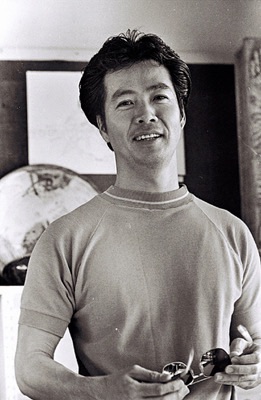
Note: This is not today’s rough draft. It’s a forever re-worked draft from a long while back. It was reworked today, and I wanted to share it. The photo was taken by my classmate at our high school during our senior year. It’s a classic photo of Mr. Yamada.
* * *
A teacher affects eternity; he can never tell where his influence stops.
Henry Adams
THE EDUCATION OF HENRY ADAMS
FROM A . . . BOX BUILDER
It was a Saturday morning, two Decembers ago.
I was sitting in almost the exact same spot where I’d sat that Saturday morning back in the fall semester of 1970, after I’d broken into the art room through a window. Back then I’d wanted to spend the day hand-building a huge pot I’d started during my ceramics class earlier in the week. This time I was working on a kind of organic sculpture vaguely resembling something between a human body and a mass of vine-like foliage.
I looked up from my work when he walked silently, as always, into the ceramics room. He smiled that soft smile of his, barely whispered a hello, and began loading articles from his ancient, green, metal desk into a small cardboard box. It looked as though he hadn’t shaved that morning, which was unusual for him. His hair wasn’t combed. I watched his swift, silent packing. There was no conversation. He finished quickly, turned to me and said, “And don’t forget–” That gentle smile spoke volumes– “to lock up, Lanning.”
I nodded. He turned away, then disappeared down the hallway. I didn’t know it then, but that was the last time I would see him at the school.
He had retired, without telling anyone, and he was gone for good to Maui.
* * *
It was August, 1970, the first day of my eleventh-grade year. Most of my closest friends had already taken ceramics, some since ninth grade.
Not a single one had ever said a negative word about the class. They all seemed to love it. I was bored. I can’t even remember what electives I’d had in ninth and tenth grade. This art class looked like a good choice.
I suppose because I was known to make a good-humored wisecrack or two on occasion, a few of my friends wanted to warn me to hold back a bit in this class.
”Eh, Lee,” Gerald advised as we went down the concrete stairs past the kiln area and into the glazing room, “watch out for Yamada. He’s a nice guy, but he’s . . . well, strict.”
”What, Gerald, no sense of humor?”
Gerald rubbed his chin. “Ah, nah, yeah, but . . . .”
Patrice laughed. “What he means, Lanny, is that Yamada isn’t going to put up with all of your lame jokes and let you be a butthead. You’ll find out the hard way if you act wise.”
”Eh, guys, my jokes aren’t that bad, are they?”
No comment.
We turned in to the ceramics room. In one corner there were three rows of stools lined up, stadium style. Standing very tall at a table in front of the stools, Mr. Yamada was nodding and smiling at both the old and the new faces. He didn’t look too mean to me, but I was curious now.
”Okay, all the old students, get working on whatever projects you want. All the new students, please take a seat on these stools.” The Japanese man gestured to the elevated rows of gray metal stools.
I don’t really know why I felt so nervous all of a sudden. “New students? That’s me,” I thought, feeling odd twinges of real dread for having consigned myself to this class. “Rules and regulations, maybe?” I wondered.
I sat in the back row. Gerald and Patrice had helped hatch a strange fear in me. I mean, Mr. Yamada seemed like a pretty nice guy, but I was worried. Something weird, some kind of bizarre vibrations were running through the novice group. Even the most notorious troublemakers, like Hama, were quickly settled and silent. We all could feel whatever it was.
After a big smile — it seemed real –and a hearty hello, Mr. Yamada pinched a handful of clay off a large, cone-shaped mound that sat on the table.
He then proceeded to mold it, quickly, into a perfectly smooth, round ball. This ball he held out to us. “I want to welcome you to Beginning Ceramics. This,” he tossed the ball lightly in the air, “is the medium you will be working with. If you look over at those shelves,” he pointed to a display area for finished projects, “you will see that we can create many different shapes –almost any shape you can imagine and then successfully engineer.” Another enormous smile.
”Do any of you know what property it is that allows us to create this wide variety of shapes?”
Silence. Blank stares. The typical student response.
”Well, let me put that another way. Do any of you know the word we use to describe the quality of clay that makes it so easy to shape?”
I was still quite nervous, but I raised my hand, very slowly.
”Yes . . . what is your name?”
”Lanny. Lanny Lee.”
”Okay, Lanny, what word do you think it is?”
Everyone had turned around to watch me. “Ah, is it ‘flexible’?”
”Flexible. That’s a very good word, Lanny. Flexible is close, but that’s not quite the word we’re looking for.”
He looked around at the other students. “Anybody else have a word.”
I raised my hand again. “Yes, Lanny,” he chuckled. “Do you want to have another go at it?”
”Ahm, how about ‘pliable’?”
”Pliable. That’s another good choice, Lanny, but it’s still not quite the word we’re after.”
My hand went up again. “Is it ‘malleable’?”
”That’s a fine guess too, Lanny, but we tend to use malleable when we talk, oh, say, about metals that are easy to work.”
”Elastic?” I questioned.
“Hmmmmm, you’re getting very warm, Lanny. You’re almost there.” He gave me what looked like a very kind, very encouraging look. But I’d run out of words. “Okay, I don’t want to wear Mr. Lee out, so I’ll tell you the word. It’s ‘plastic.’ Clay is extremely plastic. Watch how easily I can mold this into any shape I’m after.”
He stopped speaking and began to work the clay. In a matter of seconds his powerful hands and veined arms had turned the ball of clay into what he called a pinch pot. He held up the finished product. “Of course, this is a little bit easier for me because I’ve been practicing a while. But if you practice hard, too, you’ll be able to do this just as easily.”
He set the pot down on the table, picked up a piece of fishing line, and swiftly sliced the pot in half. He held the cut edges toward us. “See how thin the walls are. And notice that they are very even, though thickening slightly toward the bottom. Your first project will be to make a simple pinch pot, like this one. Are there any questions?”
There weren’t. “All right,” he said, smashing the pot back into the big cone of clay, “come with me and I’ll show you where to get your clay and how to wedge the air bubbles out of it.”
We followed quickly, in silence. I wanted to dig right in and whip out my pinch pot, but trying to figure out how to wedge the clay properly took the rest of the period.
During that week, and even the next week, I tried very hard to make the “perfect” pinch pot. Mr. Yamada would sit with each one of us, offering advice on technique. He smiled all the time and rarely spoke as loudly as he had on that first day.
With no effort at all, he had gained total control over the classroom. He dominated it. And although he appeared gentle, no one looked very anxious to cross him.
Every day I sweated blood over my latest pinch pot. Every time I thought I’d done the job, Mr. Yamada would either weigh the pot in his hand and tell me it was not proportioned correctly, or he would cut it in half and show me how uneven the walls were. My frustration mounted, but I kept trying to get it “right.”
“Don’t be afraid to destroy your work and start over,” he told me — every single time. Then he’d grin while he watched me mash my latest failure back into its little “plastic” lump.
After pinch pots, we were supposed to “master” simple coil rolling. Everyone moved busily on to making tiny coiled objects — except me. I continued to struggle with my pinch pot, the only one in the class who still did not have what Mr. Yamada would call a “keeper.” By the time he finally allowed me save my first lousy pinch pot, that still wasn’t as nice as plenty of the others — and most of those were borderline pathetic — almost everyone else had finished their stage-two coil projects.
The class moved on to slabs then, but not me.
“Try to get your coils more even, Lanny. Try to make them more uniform.”
It wasn’t easy.
“Thinner, Lanny, make them thinner.” Yeah, right, I’d think, gritting my teeth.
I’ve succeeded a little in toughening your hide.
Something was happening to me. I spent more and more time sitting there doing nothing that seemed important. I was sick of the effort it took to roll out first the “perfect” coil, then the “perfect” slab. Why did everything have to be so “perfect”? I’d thought this class was going to be easy. Why in the world did all my friends think this guy was so great anyway? He was definitely turning me off to art, as far as I was concerned.
I let myself slide. I started fooling around, wasting clay on the most peculiarly useless little projects. One day I rolled out some very thick, very uneven slabs, plastered them together into a mountain, and planted a tiny clay tree and a little clay cabin on top of it. Tom laughed at me each time he looked over at my “sculpture.” I asked him to kindly shut up.
At the end of class I was about to crush the whole thing into a “non-keeper” ball when Mr. Yamada came over to inspect my minor masterpiece.
“You have to weld that tree together a little better,” he said. “It won’t make it through the firing like that.”
”The firing?” I asked, not quite comprehending what this voice from heaven meant.
”Yes, the firing.” He walked around to the other side of the table, taking in the full effect of viewing my humble piece in the round. “You know, Lanny . . .” The considering pause was quite lengthy. “That’s the first thing you’ve ever really done. It’s definitely a keeper.”
He walked away. Patrice came over to me. “Wow, Lanny, Yamada really likes this, huh?”
“Really?” I couldn’t quite figure it out. I thought I’d been wasting time. I thought I was fooling around. I was surprised he hadn’t been upset.
Welding the tree together took some time; I was late for my next class, but Mr. Yamada wrote me a note of excuse.
From then on, Mr. Yamada rarely talked to me.
One day in late November he walked into the room. It was lunchtime, and only a few of us were spending that sacred lounging period working. I was piecing together what I seriously referred to as a “stylized goblet.” Everything I did now was taking me one step farther, each time, into the realm of the strange, the stranger, and hopefully, one day, the strangest. Mr. Yamada observed me for a while, his arms folded contemplatively across his chest.
Finally, he spoke: “You know, Lanny, if you keep this up, you could die famous.” Then he turned around and walked back out the door.
* * *
It was a Saturday morning in December, 1970.
School would be out in just under two weeks. I’d begun work on what I projected would be an enormous coil-built vase. I figured that class time and lunch time alone wouldn’t be enough to complete it. After parking my car way up on Metcalf Street, quite a distance from the art room, I walked casually down the stairs of the mountain side of the building. I tried forcing open several of the lower windows without any luck. The last window budged a little, so I put more pressure on it. Someone hadn’t secured the latch, and the window popped open. I wriggled in through the opening.
I took one of the gray metal stools off the table and then began a production line roll of coils, all of them as long and as thick as possible. With the other stools up on the tables around me, I figured I was pretty well screened from view by the security guards and other passersby. I hadn’t turned on the overhead lights either, though it was overcast and fairly dark in the room. After twenty minutes or so, I began to feel pretty relaxed and fairly sure that I was secure.
You know, Mr. Yamada had always moved silently, like a ninja in fact. He could come up right behind you, but you’d never know it until he either said something, or slid stealthily into your peripheral field of vision.
That particular morning, he turned the key in the lock and walked into the room before I even realized he was there. I was hidden from view, thanks to all of the stools, but I could neither get over to the window nor out the front door without him noticing me. I sat there petrified, wondering whether he had it in him to kill me. I watched him closely, hoping for an opportunity to escape.
I had never seen Mr. Yamada move the way he did that Saturday morning, now that he believed he was alone in the classroom. He appeared to be somehow possessed. After tossing his wallet and keys on his desk, he ripped off his shirt and quickly put on his long, blue denim smock. That smock had always hung on the hook next to his desk, but I’d never actually seen him wear it. It never seemed to get dirty.
Now, dressed for what looked like some very serious work, he took long, forceful strides to the galvanized garbage can which contained the clay.
In two or three muscular scoops, he piled up what looked to be about fifty pounds of clay.
While he manhandled the huge mound at the wedging table, he whistled, loudly, some tune which was unfamiliar to me. He hoisted the perfect cone of clay effortlessly, though I could see the muscles in his back and arms bulge. Still whistling, he walked over to the Robert Brent wheel and slammed the clay square in the middle of the bat.
He went to the sink, filled a large bowl with water, then returned to the wheel with chamois, sponge, and teasing needle in hand. The wheel engine hummed louder as the spinning mound accelerated. While he centered the clay he wiped perspiration from his forehead on his bare shoulder from time to time. I could feel the intensity of his concentration; I realized that he’d stopped whistling. All of his energy became centered in the clay. I’d never seen anyone throw such a huge mass at one time.
And then it happened. He suddenly stood up and took several forceful steps in my direction. He stopped. We were looking each other in the eye.
He smiled. “Oh,” he said softly, “hello, Lanny. Working hard, are we?”
I nodded, at most, a weak yes. I wondered what he’d do to me. He walked by me, picked up several empty boards, and returned to the wheel.
He went back to work, throwing perfect tea bowls, one after another, maybe fifty of them, or more. After I realized our conversation was over, I went back to building my vase. I didn’t feel very relaxed for some time, but gradually I lost myself in the work. Like he had, the instant he stopped talking to me.
My vase had grown by about two feet when I noticed him putting his shirt back on. “Lanny, I’ve set the lock, so all you have to do is slam the door when you leave. And,” he smiled, “make sure the windows are latched . . . tight.”
”Okay, sure. Yes, Mr. Yamada, I will.” That afternoon, after double-checking all the windows and before slamming the door securely shut, I inspected the blue smock. It was still spotlessly clean.
On Monday morning, Mr. Yamada gave me a set of keys to all the art rooms in Castle Memorial Hall. He also gave me a letter, addressed to the security guards, stating that any students who were working after hours and on weekends were authorized, by him, to do so. By the time senior year rolled around, many of us were in the art wing at all hours of the day and night. Mr. Yamada taught everyone how to operate the kiln. Production was up so much that he, alone, couldn’t possibly manage to bisque and fire all our work.
When I graduated from the Lab School in 1972, I asked Mr. Yamada to sign my annual. My slab technique must have improved quite a bit. This is what he wrote:
Aloha to a Super Box Builder:
Lanning, it was rough going, but I think I’ve succeeded a little in toughening your hide.
Shige Yamada
* * *
But the story doesn’t quite end there. I’ve come back to the Lab School, a teacher now. When I first ran into Mr. Yamada, I called him “Mr. Yamada.”
He smiled that same, old, mysterious smile, and said in that same, gentle voice: “Lanning, we’re colleagues now. You don’t have to call me Mr. Yamada. Please, call me Shige.”
”Okay, Mr. . . . Shige,” I said. I nearly choked on the words.
Before that final Saturday morning, two Decembers ago, I must have seen him day after day after day. But I could only ever manage to call him “Shige” that one time. Every time afterwards, I addressed him as “Mr. Yamada.” Each time I said it, he would smile.
It’s a good thing my hide is so tough these days.
 Lanning Lee